


Life Sciences - Neurobiology Track (.M.Sc) (.M.Sc)
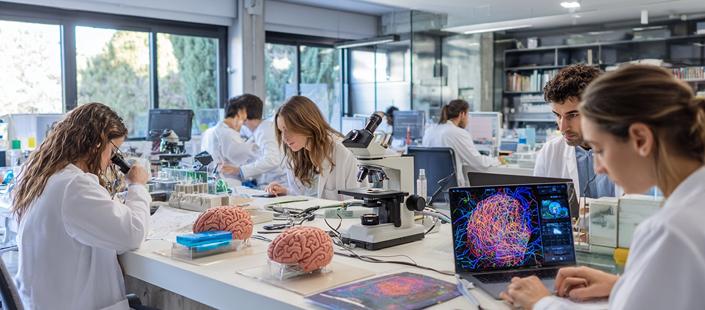
What will you study, and why should you study at Bar-Ilan?
Neurobiology examines how neural activity and neural networks give rise to cognitive processes such as thinking, decision‑making, memory and learning, and how alterations in these mechanisms shape human and animal behavior and function.
This understanding helps identify key principles of normal and altered neural activity and deepens our insight into the relationships between brain function, cognition, and behavior. It also serves as a foundation for advanced research in the life sciences and for developing new lines of inquiry in related fields.
The thesis-track Master’s program in Life Sciences - Neurobiology track focuses on the cellular and molecular biology of nervous systems in humans and animals. Throughout the program, students gain theoretical knowledge and hands‑on experience in core topics such as brain and behavioral mechanisms, cognitive processes and decision‑making, memory and learning, neural plasticity, and neurogenesis.
Studies are centered on an independent research project supervised by a senior faculty member from one of the research groups in the Faculty of Life Sciences. Students work closely with researchers, gain exposure to cutting‑edge scientific advances, and utilize state‑of‑the‑art research technologies and methodologies.
Career Opportunities
Graduates of the thesis-track Master’s program in Life Sciences - Neurobiology track gain rigorous research training that enables them to integrate into a wide range of scientific and applied settings. These include academic research laboratories (including continuation to Ph.D. studies), research institutes, hospitals and clinical research units, biotech and pharmaceutical companies, drug development, medical device development, as well as start‑ups in the fields of neuroscience and biomedical sciences.
In addition, the program’s broad research training in the life sciences allows graduates to enter other related fields, depending on the focus of their research, the practical experience they acquire, and the expertise they develop throughout the degree.
Program Structure
The duration of the thesis-track Master’s degree in Life Sciences -Neurobiology track is two years, during which students complete their research project and write their thesis (excluding any prerequisite completion year, if required).
Studies begin in Semester A, and the research phase officially starts on October 1 each year.
The program comprises a total of 40 credit points:
- 24 credits of coursework
- 16 credits for the research thesis
The final degree grade is determined according to university regulations: 75% based on the research thesis and 25% based on coursework.
*Program requirements do not include university‑wide obligations for Jewish studies and Israeli culture courses or general courses.
Program Courses
During the program, students must complete required courses, seminars, and a written thesis, in accordance with the Faculty of Life Sciences regulations:
- In the first year of study, students must enroll in the following courses: Principles of Scientific Instrumentation and Data Analysis (80801) and Biostatistics and Introduction to Clinical Trials (80534).
- In the second year of study, students must enroll in the thesis research code.
- Students are required to register annually for the departmental Colloquium (Faculty Seminar) (809000-01).
- Students must also choose two seminars from the program’s approved seminar list.
- Students may take up to 4 credits of research-relevant courses in other departments, subject to approval.
The research proposal must be submitted at the end of the first year. A change in research topic or supervisor may require additional coursework, as determined by faculty regulations.
The final degree grade is determined according to university regulations: 75% based on the research thesis and 25% based on coursework.
*Program requirements do not include university‑wide obligations for Jewish studies and Israeli culture courses or general courses.
Activities and Practical Experience
Engagement with research questions in the field of nervous‑system biology is expressed through an independent, supervised research project (thesis), conducted under the guidance of a senior faculty member in one of the research groups within the Faculty of Life Sciences. As part of this process, students become integrated into active laboratories, work directly with researchers, and gain exposure to cutting‑edge studies in brain and nervous‑system science.
Throughout their research, students combine theoretical knowledge with experimental practice, address complex scientific questions, and acquire advanced research skills. These include designing and conducting experiments, analyzing data, and presenting research findings in academic settings.
Research in the Neurobiology track involves the use of advanced methods commonly applied in the study of nervous systems. Depending on the nature of the project, these may include cellular and molecular biology techniques, advanced microscopy and imaging, neural activity analysis, and the integration of computational and bioinformatics tools.
Admission Requirements
Academic Average:
- A minimum average of 80 in a relevant Bachelor’s degree is required.
- Applicants with an average below 85 will be required to attend an interview with the admissions committee.
Supervisor Identification:
- Admission is contingent upon identifying a potential supervisor and obtaining their formal approval prior to enrollment.
- It is recommended that prospective students contact potential supervisors in advance to confirm their availability for mentoring.
- The Faculty website publishes a list of faculty members who are interested in supervising M.Sc. students; however, students may also reach out to supervisors who do not appear on this list.
- Admission to the program is only finalized after the supervisor formally confirms to the Faculty’s Graduate Studies Office that they agree to mentor the candidate
Contact Information
Want to learn more about the M.Sc. in Life Sciences - Neurobiology Track?
- Associate Dean for Graduate Studies: Prof. Galit Shochat-Ofir
- Academic Advisor for Graduate Studies: Dr. Hila Alipantz
- Graduate Student Coordinator: Ms. Shani Hazan – Ls.Graduates@biu.ac.il
- Scholarships Officer: Ortal Zah
-

Prof. Appelbaum Lior
972-3-7384536 (office); 972-3-7384538 (lab); 972-3-7384537 (student room) -

Prof. Emeritus Brodie Chaya
972-3-5318266 -
Prof. Korngreen Alon
972-3-5318224 -

Prof. Okun Eitan
972-3-7384671 (office); 972-3-7384670 (lab) -

Prof. Opatowsky Yarden
972-3-5318330 -
Prof. Shohat-Ophir Galit
972-3-7384208 (office); 972-3-7384209 (lab) -

Prof. Yadid Gal
972-3-5318123
Last Updated Date : 15/06/2026