



Prof. Nissan Yissachar
Host-Microbiome Interactions, Gut Microbiota, Mucosal Immunology, Enteric Neuro-Immune Crosstalk, Gut-Brain Axis, Intestinal Barrier Function, 3D Gut Organ Culture System, Microbial Metabolites, Cancer Immunotherapy, Antitumor Immunity, Inflammatory Bowel Diseases, Optogenetics
Research
Yissachar lab - Host microbiome interactions
Our research focuses on decoding the three-way interactions between the gut microbiota, host immunity, and the enteric nervous system. Operating at the intersection of mucosal immunology and the gut–brain axis, we seek to understand how microbial signals and metabolites shape immune responses both locally and systemically, and how enteric neural circuits sense and coordinate these pathways.
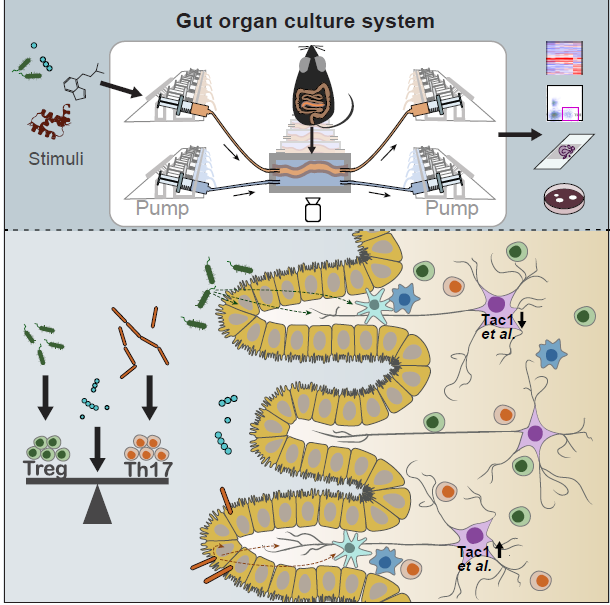
What sets our laboratory apart is our reliance on specialized experimental platforms, most notably an ex vivo 3D gut organ culture system and the ex vivo intestinal permeability assay (X-IPA). By preserving the complexity of intact intestinal tissue, these technologies allow us to monitor cellular dynamics and intestinal barrier function in real time, bridging the gap between simplified cell lines and complex in vivo models.
Our ongoing efforts span three primary research programs:
Immuno-Oncology: Identifying specific commensal microbes and bioactive microbial metabolites that may enhance responses to immune checkpoint blockade and promote antitumor immunity, while preserving intestinal epithelial barrier function and mucosal homeostasis.
Intestinal Injury and Inflammation: Mapping the cellular mechanisms underlying intestinal mucosal damage associated with chemotherapy and inflammatory bowel diseases (IBD), with the aim of identifying therapeutic targets that could promote epithelial repair.
Enteric Neuro-Immunology: Combining optogenetics with multi-omics approaches to investigate how enteric neurons respond to microbial signals and influence intestinal immune activity, revealing mechanisms of neuro-immune communication.
Across these research programs, our goal is to translate mechanistic insights into microbiome-targeted precision medicine.
Publications
Selected Publications
1. Yissachar, N., Zhou, Y., Ung, L., Lai, N. Y., Mohan, J. F., Ehrlicher, A., Weitz, D. A., Kasper, D. L., Chiu, I. M., Mathis, D., & Benoist, C. (2017). An intestinal organ culture system uncovers a role for the nervous system in microbe-immune crosstalk. Cell, 168(6), 1135–1148.e12.
https://doi.org/10.1016/j.cell.2017.02.009
Introduces an intestinal organ culture system that preserves tissue architecture and reveals how gut bacteria activate sensory neurons, suggesting that neuronal signaling helps determine whether microbial interactions trigger pro-inflammatory or regulatory immune responses.
2. Bootz-Maoz, H., Pearl, A., Melzer, E., Malnick, S., Sharon, E., Bennet, Y., Tsentsarevsky, R., Abuchatzera, S., Amidror, S., Aretz, E., Azriel, S., Gam Ze Letova, C., Naama, M., Shoval, I., Yaron, O., Karako-Lampert, S., Bel, S., & Yissachar, N. (2022). Diet-induced modifications to human microbiome reshape colonic homeostasis in irritable bowel syndrome. Cell Reports, 41(7), 111657.
https://doi.org/10.1016/j.celrep.2022.111657
Demonstrates that dietary changes in patients with irritable bowel syndrome alter the gut microbiome's effects on intestinal tissue, identifying Bifidobacterium adolescentis as a diet-sensitive bacterium that disrupts intestinal barrier function and providing mechanistic support for microbiome-targeted approaches to IBS.
3. Bootz-Maoz, H., Simon, A., Del Mare-Roumani, S., Bennet, Y., Toister, E., Romano, H., Zheng, D., Amidror, S., Elinav, E., & Yissachar, N. (2023). Ex vivo intestinal permeability assay (X-IPA) for tracking barrier function dynamics. npj Biofilms and Microbiomes, 9, 44.
https://doi.org/10.1038/s41522-023-00409-0
Develops an ex vivo method for measuring changes in intestinal permeability in real time, demonstrating how specific gut bacteria and microbial metabolites can rapidly alter barrier function and providing a tool for investigating the mechanisms underlying intestinal health and disease.
4. Naim, G., Romano-Zadaka, H., Amidror, S., Jessula Levy, D., Cohen, A., Sochen, C., Gilberg, H., Farah, N., Rudenko, V., Yarden, Y., Feng, M., Tsentsarevsky, R., Brodie, Z., Reich, Y., Simon, A., Toister, E., Shoval, I., Armon, L., Schiller, M., Mandel, Y., Biton, M., & Yissachar, N. (2025). Optogenetics-integrated gut organ culture system connects enteric neurons dynamics and gut homeostasis. Nature Communications, 16, 10010.
https://doi.org/10.1038/s41467-025-64995-7
Develops an optogenetics-integrated intestinal culture system that enables precise control of enteric neurons, demonstrating how distinct neuronal populations and activity patterns regulate intestinal immune responses and epithelial barrier integrity, and how gut bacteria can modify these effects.
5. Bootz-Maoz, H., Del Mare-Roumani, S., Naim, G., Azriel, O., Cohen, A., Bennet, Y., Sharon, E., Amidror, S., & Yissachar, N. (2026). Uncoupling drug and microbiota contributions to chemotherapy-induced gut toxicity. bioRxiv [Preprint].
https://doi.org/10.64898/2026.06.30.735444
Shows in experimental models that chemotherapy and the resulting changes in gut microbiota can independently damage the intestinal barrier through distinct biological pathways, identifying microbiome disruption as a potential target for reducing chemotherapy-associated gastrointestinal toxicity.
Media
Video – The Dangoor Center for Personalized Medicine | The Dangoor Center for Personalized Medicine, Bar-Ilan University | November 24, 2025
Video – Brain Science at Bar-Ilan University | Brain Science at Bar-Ilan University | November 24, 2025
Friends from the Gut: How Do Gut Bacteria Affect Our Health? Dr. Nisan Yissachar, Bar-Ilan University | YouTube | April 19, 2020
Last Updated Date : 25/10/2026