
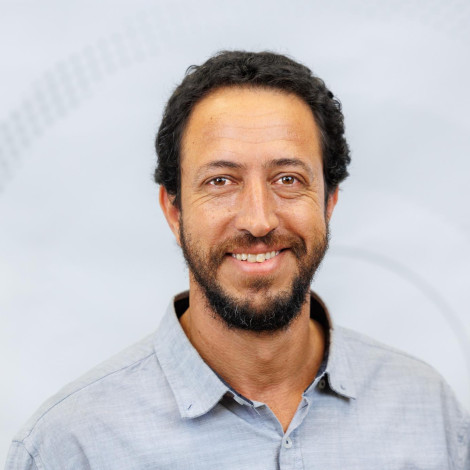
Dr. Gal Eyal
Coral reefs; Mesophotic Coral Ecosystems; ROV; Red Sea; Coral Biology; Marine Ecology; Historical Ecology; Palaeoecology; Rariphotic zone; Baited Remote Underwater Video systems (BRUVs); Current–temperature coupling; Seasonal circulation; Species richness; Environmental gradients.
CV
Research
The Marine Ecosystem Dynamics Laboratory
The Marine Ecosystem Dynamics Lab (MEDsLab) studies coral reefs and marine ecosystems along the continental shelf, from shallow waters through Mesophotic Coral Ecosystems (MCEs) (~30–150 m) to the rariphotic zone (~150–300 m), where light all but disappears. Using reef-building corals as its main model, the lab investigates coral biology and marine ecology across environmental gradients and seeks to distinguish natural variability from human impacts such as warming, pollution, and sedimentation.
Key questions include how corals and their symbiotic algae adjust photosynthesis, fluorescence, and reproduction as light fades with depth; whether deep reefs can act as refugia from marine heatwaves and bleaching; and what drives species richness and taxonomic and functional rarity along depth and other environmental gradients.
Current projects include remotely operated vehicle (ROV) surveys of Eilat's submarine canyons, examining how depth and canyon morphology shape fish assemblages; palaeoecological and historical-ecology reconstruction of mesophotic reefs from coral-rubble cores, using dating and sedimentary ancient DNA; and AI tools that identify and measure organisms in underwater imagery and propose literature-grounded hypotheses. Baited Remote Underwater Video systems (BRUVs) are also used to investigate marine communities and their distribution across depth and environmental gradients.
The lab is distinctive in integrating depth, space, and time, pairing technical diving, 3D photogrammetry, and reciprocal transplants across depths with environmental DNA and AI. Its research also examines physical oceanographic processes, including current–temperature coupling and seasonal circulation, and their relationships with marine ecosystem patterns. Fieldwork centers on the Red Sea, particularly the Gulf of Eilat/Aqaba, where deep reefs lie close to shore, with comparative sites in the Mediterranean and on the Great Barrier Reef of Australia.
Courses
2023-now Biology for Physics
2024-now General Biology 1 (in English)
2024-now Introduction to the Mediterranean Sea (Interuniversity by MERCI)
2023-now Biotechnology Research Advanced Lab
2023-now Ecology Seminar (BSc)
2023-now General Seminar (MSc & PhD)
Publications
Selected Publications
1. Haim A, Eyal G (2026). Five decades of rariphotic research: a systematic review of trends, biases, and future directions. Preprint.
https://doi.org/10.64898/2026.07.07.736978
A systematic review of five decades of research in the rariphotic zone, identifying major trends, geographic and methodological biases, knowledge gaps, and priorities for future research. (Preprint; not yet peer reviewed.)
2. Eyal G, Laverick JH, Ben-Zvi O, Brown KT, Kramer N, Tamir R, Lindemann Y, Levy O, Pandolfi JM (2022). Selective deep water coral bleaching occurs through depth isolation. Science of the Total Environment 844: 157180.
https://doi.org/10.1016/j.scitotenv.2022.157180
Documents three mesophotic-specific coral bleaching events in the northern Red Sea, challenging the capacity of deep coral reefs to serve as universal refugia from climate-driven warming and bleaching.
3. Hammerman NM, Roff G, Rodriguez-Ramirez A, Leonard N, Staples TL, Eyal G, Rossbach S, Havlik MN, Saderne V, Zhao JX, Duarte CM, Pandolfi JM (2022). Reef accumulation is decoupled from recent degradation in the central and southern Red Sea. Science of the Total Environment 809: 151176.
https://doi.org/10.1016/j.scitotenv.2021.151176
Uses palaeoecological reconstruction and U-Th dating to examine long-term changes in coral community composition and reef accumulation in the central and southern Red Sea.
4. Eyal G, Laverick JH, Bongaerts P, Levy O, Pandolfi JM (2021). Mesophotic coral ecosystems of the Great Barrier Reef are understudied and underexplored. Frontiers in Marine Science 8: 622856.
https://doi.org/10.3389/fmars.2021.622856
Identifies major research gaps in the mesophotic coral ecosystems of the Great Barrier Reef and highlights priorities for expanding research and management of these underexplored deep-reef habitats.
5. Laverick JH, Tamir R, Eyal G, Loya Y (2020). A generalized light-driven model of community transitions along coral reef depth gradients. Global Ecology and Biogeography 29: 1554–1564.
https://doi.org/10.1111/geb.13140
Develops a process-based model showing how light can drive transitions in coral communities along shallow-to-mesophotic reef depth gradients.
6. Wiedenmann J, D'Angelo C, Mardones ML, Moore S, Benkwitt CE, Graham NAJ, Hambach B, Wilson PA, Vanstone J, Eyal G, Ben-Zvi O, Loya Y, Genin A (2023). Reef-building corals farm and feed on their photosynthetic symbionts. Nature 620: 1018–1024.
https://doi.org/10.1038/s41586-023-06442-5
Reveals how reef-building corals obtain essential nutrients by farming and feeding on their photosynthetic symbionts, helping explain their success in nutrient-poor waters.
7. Ben-Zvi O, Lindemann Y, Eyal G, Loya Y (2022). Coral fluorescence: a prey-lure in deep habitats. Communications Biology 5: 537.
https://doi.org/10.1038/s42003-022-03460-3
Provides experimental evidence that coral fluorescence can function as a prey lure in mesophotic habitats, enhancing our understanding of how corals obtain food in low-light environments.
8. Alonso I, Yuval M, Eyal G, Treibitz T, Murillo AC (2019). CoralSeg: learning coral segmentation from sparse annotations. Journal of Field Robotics 36: 1456–1477.
https://doi.org/10.1002/rob.21915
Develops a deep-learning approach for coral-reef image segmentation using sparse annotations, substantially reducing the expert labeling required for automated analysis of underwater imagery.
Book chapters (peer-reviewed):
DOI: 10.1007/978-3-319-92735-0_11
DOI: 10.1007/978-3-319-92735-0_52
Media
- מה שיותר עמוק יותר לבן | ZAVIT – Science and Environment News Agency | 12.08.2022 | Feature on coral bleaching at mesophotic depths in the Gulf of Eilat/Aqaba, including insights from Gal Eyal on deep-reef responses to environmental change.
- A new hope for coral reefs | CORDIS – European Commission | 17.02.2023 | Feature presenting the results of Gal Eyal’s MSCA research on mesophotic coral ecosystems and the potential of deeper reefs to contribute to coral-reef resilience.
- Why corals glow even in the depths of the sea | ScienceDaily | 17.07.2022 | Research feature on coral fluorescence as a mechanism for attracting prey in deep, low-light habitats, based on a study co-authored by Gal Eyal.
- Early Career Scientist: Gal Eyal | Mesophotic.org | 24.08.2020 | Interview with Gal Eyal about coral-reef research across depth gradients, mesophotic ecosystems, and deep diving in the Gulf of Eilat/Aqaba.
YouTube interview | YouTube | Interview with Gal Eyal about research across coral-reef depth gradients and deep diving in the Gulf of Eilat/Aqaba.
Last Updated Date : 13/10/2026